 Judaism 101
Judaism 101
Judaism 101
Level: Basic
There are many traditional symbols that you may see in Jewish households or synagogues. Some of these items are religiously required, or have deep religious significance. Some are merely customary but are common and familiar.

And you shall write [the words that I command you today] on the doorposts of your house and on your gates. (Deuteronomy 6:9, Deuteronomy 11:19)
On the doorposts of traditional Jewish homes (and many not-so-traditional homes!), you will find a small case like the one pictured at right. This case is commonly known as a mezuzah (Heb.: doorpost), because it is placed upon the doorposts of the house. The mezuzah is not, as some suppose, a good-luck charm, nor does it have any connection with the lamb's blood placed on the doorposts in Egypt. Rather, it is a constant reminder of G-d's presence and G-d's mitzvot.
The mitzvah to place mezuzot on the doorposts of our houses is derived from Deut. 6:4-9, a passage commonly known as the Shema (Heb: Hear, from the first word of the passage). In that passage, G-d commands us to keep His words constantly in our minds and in our hearts by (among other things) writing them on the doorposts of our house. The words of the Shema are written on a tiny scroll of parchment, along with the words of a companion passage, Deut. 11:13-21. On the back of the scroll, a name of G-d is written. The scroll is then rolled up and placed in the case, so that the first letter of the Name (the letter Shin) is visible (or, more commonly, the letter Shin is written on the outside of the case).
The scroll must be handwritten in a special style of writing and must be placed in the case to fulfill the mitzvah. It is commonplace for gift shops to sell cases without scrolls, or with mechanically printed scrolls, because a proper scroll costs more than even an elaborately decorated case ($30-$50 for a valid scroll is quite reasonable). According to traditional authorities, mechanically printed scrolls do not fulfill the mitzvah of the mezuzah, nor does an empty case.
The case and scroll are then nailed or affixed at an angle to the right side doorpost as you enter the building or room, with a small ceremony called Chanukat Ha-Bayit (dedication of the house - yes, this is the same word as Chanukah, the holiday celebrating the rededication of the Temple). A brief blessing is recited. See the text of the blessing at Affixing the Mezuzah.
Why is the mezuzah affixed at an angle? The rabbis could not decide whether it should be placed horizontally or vertically, so they compromised!
Every time you pass through a door with a mezuzah on it, you touch the mezuzah and then kiss the fingers that touched it, expressing love and respect for G-d and his mitzvot and reminding yourself of the mitzvot contained within them.
It is proper to remove a mezuzah when you move, and in fact, it is usually recommended. If you leave it in place, the subsequent owner may treat it with disrespect, and this is a grave sin. I have seen many mezuzot in apartment complexes that have been painted over because a subsequent owner failed to remove it while the building was painted, and it breaks my heart every time I see that sort of disrespect to an object of religious significance.
For more information about mezuzot or to purchase valid scrolls for a mezuzah online, visit the S.T.A.M. website.
They shall make themselves tzitzit on the corners of their garments throughout their generations, and they shall place on the tzitzit of each corner a thread of techeilet. And it shall be tzitzit for you, and you will see it, and you will remember all the mitzvot of the L-RD and do them and not follow your heart or your eyes and run after them. (Numbers 15:38-40)
The Torah commands us to wear tzitzit at the corners of our garments as a reminder of the mitzvot. The word tzitzit is usually translated as fringes, but they are really more like tassels (the strings on a mortarboard that are moved from right to left at a college student's graduation) attached to each corner of the tallit. They are kind of like the old technique of tying a string around your finger to remember something. The passage also instructs that the tzitzit should have a thread of "techeilet," believed to be a blue or turquoise dye, but the source of that dye is no longer known, so tzitzit today are usually all white. There is a complex procedure for tying the knots of the tzitzit, filled with religious and numerological significance. They are usually (but not always!) pre-tied to a garment (the tallit) when purchased.
The mitzvah to wear tzitzit applies only to four-cornered garments, because the passage speaks of attaching tzitzit to the corners of the garments. Four-cornered garments were common in biblical times but are not common anymore. To fulfill this mitzvah, adult men wear a four-cornered shawl called a tallit during morning services, along with the tefillin. In some Orthodox congregations, only married men wear a tallit; in others, both married and unmarried men wear one. In Conservative, Reform and Reconstructionist synagogues, both men and women may wear a tallit, but men are somewhat more likely than women to do so. A blessing is recited when you put on the tallit. See the text of the blessing at Tallit and Tefillin.
Strictly observant Jewish men commonly wear a special four-cornered garment, similar to a poncho, called a tallit katan ("little tallit"), so that they will have the opportunity to fulfill this important mitzvah all day long. The tallit katan is worn under the shirt, with the tzitzit hanging out so they can be seen. If you've ever seen a Jewish man with strings hanging out of his clothing, this is probably what you were seeing.
There is no particular religious significance to the tallit (shawl) itself, other than the fact that it holds the tzitzit (tassels) on its corners. There are also very few religious requirements with regard to the design of the tallit. The tallit must be long enough to be worn over the shoulders (as a shawl), not just around the neck (as a scarf), to fulfill the requirement that the tzitzit be on a "garment." Likewise, it should be draped over the shoulders like a shawl, not worn around the neck like a scarf, though that is commonly done. A longer tallit is commonly folded over the shoulders, to prevent the tzitzit from dragging on the ground. The tallit may be made of any material, but must not be made of a combination of wool and linen, because that combination is forbidden on any clothing. (Lev. 19:19; Deut. 22:11). Most tallitot are white with navy or black stripes along the shorter ends, possibly in memory of the thread of techeilet. They also commonly have an artistic motif of some kind along the top long end (the outside of the part that goes against your neck). This motif is referred to as an atarah (crown). There is no particular religious significance to the atarah; it simply tells you which end is up! In fact, a rabbi in the 1600s theorized that the atarah serves as padding, to prevent the tallit from wearing out in the area that rubs up against the bare neck! It is quite common, however, to write the words of the blessing for putting on the tallit on the atarah, so you can read the blessing while you are putting the tallit on. In this blessing, the Hebrew letter Dalet is substituted for the Name of G-d in the blessing, because you wouldn't want to put the Divine Name or even any close substitute in the laundry.
If a blessing is written on your tallit, you should be careful not to bring the tallit into the bathroom with you! Sacred writings should not be brought into the bathroom. For this reason, many synagogues have a tallit rack outside of the bathroom. Conversely, if you see a room in a synagogue with a sign that tells you to remove your tallit before entering, you can safely assume that the room is a bathroom!
Bind [the words that I command you today] as a sign on your arm, and they shall be ornaments between your eyes. (Deuteronomy 6:8)
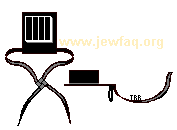 The Shema also commands us to bind the words to our hands and between our eyes. We do this by "laying
tefillin," that is, by binding to our arms and foreheads leather pouches containing scrolls of
Torah passages.
The Shema also commands us to bind the words to our hands and between our eyes. We do this by "laying
tefillin," that is, by binding to our arms and foreheads leather pouches containing scrolls of
Torah passages.
The word "tefillin" is usually translated "phylacteries," although I don't much care for that term. "Phylacteries" isn't very enlightening if you don't already know what tefillin are, and the word "phylacteries" means "amulet," suggesting that tefillin are some kind of protective charm, which they are not. The word "tefillin," on the other hand, is etymologically related to the word "tefilah" (prayer) and the root Pe-Lamed-Lamed (judgment).
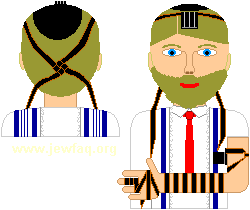 Like the mezuzah, tefillin are meant to remind us of G-d's
mitzvot. We bind them to our head and our arm, committing both our intellect
and our physical strength to the fulfillment of the mitzvot. At weekday morning
services, one case is tied to the arm, with the scrolls at the biceps and
leather straps extending down the arm to the hand, then another case is tied to the head, with the case on
the forehead and the straps hanging down over the shoulders. Appropriate
blessings are recited during this process. The tefillin are removed at the
conclusion of the morning services. See a general outline of this process and its blessings at
Tallit and Tefillin.
Like the mezuzah, tefillin are meant to remind us of G-d's
mitzvot. We bind them to our head and our arm, committing both our intellect
and our physical strength to the fulfillment of the mitzvot. At weekday morning
services, one case is tied to the arm, with the scrolls at the biceps and
leather straps extending down the arm to the hand, then another case is tied to the head, with the case on
the forehead and the straps hanging down over the shoulders. Appropriate
blessings are recited during this process. The tefillin are removed at the
conclusion of the morning services. See a general outline of this process and its blessings at
Tallit and Tefillin.
Jewish acupuncturist Steven Schram examined the positioning of the tefillin and the procedure for laying them, and concluded that the laying of tefillin was "a unique way of stimulating a very precise set of acupuncture points that appears designed to clear the mind and harmonise the spirit." Click here to see his article from the Journal of Chinese Medicine.
Like the scrolls in a mezuzah, the scrolls in tefillin must be hand-written in a special style of writing. A good, valid set of tefillin can cost a few hundred dollars, but if properly cared for they can last for a lifetime.
For more information about tefillin or to purchase valid tefillin online, visit the S.T.A.M. website.
One of the oldest symbols of the Jewish faith is the menorah, a seven-branched candelabrum used in the Temple. The kohanim lit the menorah in the Sanctuary every evening and cleaned it out every morning, replacing the wicks and putting fresh olive oil into the cups. The illustration at left is based on instructions for construction of the menorah found in Ex. 25:31-40.
It has been said that the menorah is a symbol of the nation of Israel and our mission to be "a light unto the nations." (Isaiah 42:6). The sages emphasize that light is not a violent force; Israel is to accomplish its mission by setting an example, not by using force. This idea is highlighted in the vision in Zechariah 4:1-6. Zechariah sees a menorah, and G-d explains: "Not by might, nor by power, but by My spirit."
The lamp stand in today's synagogues, called the ner tamid (lit. the continual light, usually translated as the eternal flame), symbolizes the menorah. Many synagogues also have an ornamental menorah, usually with some critical detail changed (for example, with only 6 candles) to avoid the sin of reproducing objects of the Temple.
The nine-branched menorah used on Chanukah is commonly patterned after this menorah, because Chanukah commemorates the miracle that a day's worth of oil for this menorah lasted eight days.
Cover your head so that the fear of heaven may be upon you. -Talmud Shabbat 156b
R. Huna son of R. Joshua would not walk four cubits bareheaded, saying: The Shechinah [Divine Presence] is above my head. (Talmud Kiddushin 31a)
R. Huna son of R. Joshua said: May I be rewarded for never walking four cubits bareheaded. -Talmud Shabbat 118b
The most commonly known and recognized piece of Jewish garb is actually the one with the least religious significance. The word yarmulke (usually, but not really correctly, pronounced YAH-mick-kuh) is Yiddish. According to Leo Rosten's The Joys of Yiddish, it comes from a Tartar word meaning skullcap. According to some Orthodox and Chasidic rabbis I know, it comes from the Aramaic words "yerai malka" (fear of or respect for The King, that is, the King of the Universe). The Hebrew word for this head covering is kippah (pronounced KEY-pah).
It is an ancient practice for Jews to cover their heads during prayer. This probably derives from the fact that in Eastern cultures, it is a sign of respect to cover the head (the custom in Western cultures is the opposite: it is a sign of respect to remove one's hat). Thus, by covering the head during prayer, one showed respect for G-d. In addition, in ancient Rome, servants were required to cover their heads while free men did not; thus, Jews covered their heads to show that they were servants of G-d. In medieval times, Jews covered their heads as a reminder that G-d is always above them.
Whatever the reason given, however, covering the head has always been regarded more as a custom rather than a commandment. Although it is a common pious practice to cover the head at all times, it is not religiously mandatory. For example, it is widely accepted that one may refrain from wearing a head covering at work if your employer requires it (for reasons of safety, uniformity, or to reduce distractions). You can take off your yarmulke for a job interview if you think it will hurt your chances of getting the job. There is an amusing article about this dilemma, The Kippah Debate, at Aish.com.
There is no special significance to the yarmulke as a specific type of head covering. Its light weight, compactness and discreteness make it a convenient choice of head gear. I am unaware of any connection between the yarmulke and the similar skullcap worn by the Pope.
The
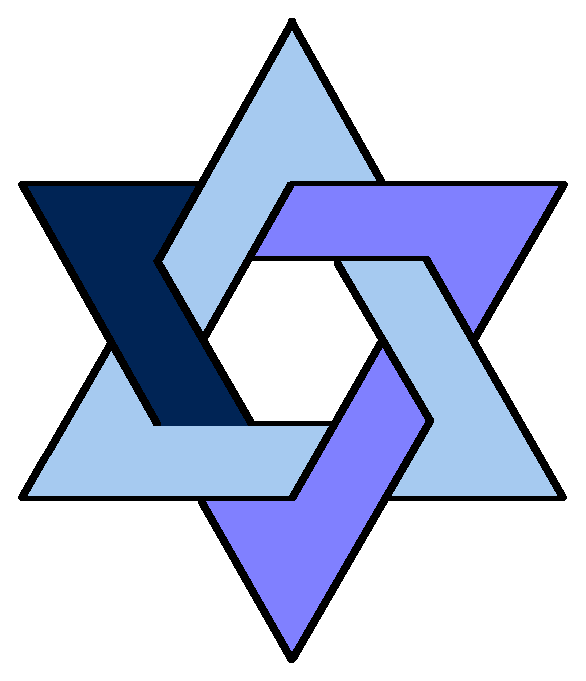
Magen David (Shield of David, or as it is more commonly known, the Star of David) is the symbol most commonly
associated with Judaism today, but it is actually a relatively new Jewish symbol. It is supposed to represent
the shape of King David's shield (or perhaps the emblem on it), but there is really no support for that claim
in any early rabbinic literature. The symbol is not mentioned in rabbinic
literature until the middle ages, and is so rare in early Jewish literature and artwork that art dealers
suspect forgery if they find the symbol in early Jewish works.
Scholars such as Franz Rosenzweig have attributed deep theological significance to the symbol. For example, some note that the top triangle strives upward, toward G-d, while the lower triangle strives downward, toward the real world. Some note that the intertwining makes the triangles inseparable, like the Jewish people. Some say that the three sides represent the three types of Jews: Kohanim, Levites and Israel. Some note that there are actually 12 sides (3 exterior and 3 interior on each triangle), representing the 12 tribes. While these theories are theologically interesting, they have little basis in historical fact.
The symbol of intertwined equilateral triangles is a common one in the Middle East and North Africa, and is thought to bring good luck. It appears occasionally in early Jewish artwork, but never as an exclusively Jewish symbol. The nearest thing to an "official" Jewish symbol at the time was the menorah.
In the middle ages, Jews often were required to wear badges to identify themselves as Jews, much as they were in Nazi Germany, but these Jewish badges were not always the familiar Magen David required by the Nazis. For example, a fifteenth century painting by Nuno Goncalves features a rabbi wearing a six-pointed badge that looks more or less like an asterisk.
In the 17th century, it became a popular practice to put Magen Davids on the outside of synagogues, to identify them as Jewish houses of worship in much the same way that a cross identified a Christian house of worship; however, I have never seen any explanation of why this symbol was chosen, rather than some other symbol.
The Magen David gained popularity as a symbol of Judaism when it was adopted as the emblem of the Zionist movement in 1897, but the symbol continued to be controversial for many years afterward. When the modern state of Israel was founded, there was much debate over whether this symbol should be used on the flag.
Today, the Magen David is the universally recognized symbol of Jewry. It appears on the flag of the state of Israel, and the Israeli equivalent of the Red Cross is known as the Red Magen David.
This symbol, commonly seen on necklaces and other jewelry and ornaments, is simply the Hebrew word Chai (living), with the two Hebrew letters Cheit and Yod attached to each other. Some say it refers to the Living G-d; others say it simply reflects Judaism's focus on the importance of life. Whatever the reason, the concept of chai is important in Jewish culture. The typical Jewish toast is l'chayim (to life). Gifts to charity are routinely given in multiples of 18 (the numeric value of the word Chai).
The hamesh hand or hamsa hand is a popular motif in Jewish jewelry. Go into any Judaic gift shop and you will find necklaces and bracelets bearing this inverted hand with thumb and pinky pointing outward. The design commonly has an eye in the center of the hand or various Hebrew letters in the middle.
There is nothing exclusively Jewish about the hamesh hand. Arab cultures often refer to it as the Hand of Fatima, which represents the Hand of G-d. Similar designs are common in many cultures. Why it has become such a popular symbol among Jews? I haven't been able to find an adequate explanation anywhere. My best guess: in many cultures, this hand pattern represents a protection against the evil eye (a malignant spiritual influence caused by the jealousy of others), and the evil eye has historically been a popular superstition among Jews.
For some lovely illustrations of Jewish variations on this design, see here.
 Affixing a Mezuzah
Donning Tallit and Tefillin
Affixing a Mezuzah
Donning Tallit and Tefillin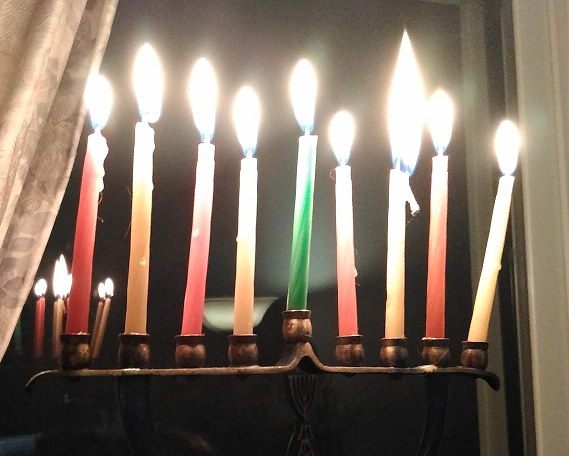 Chanukah